Choosing a Sex AI Companion by Interaction Style
Picking by appearance is the fastest route to churning through characters without keeping any of them. The category's own wording points somewhere more durable — Sex AI companions that adapt to your personality and remember your preferences — and it is the interaction style, not the card art, that decides whether a second session feels better than the first.

Key takeaways
- Score four style axes before opening anything: pace, initiative, register and scenario appetite.
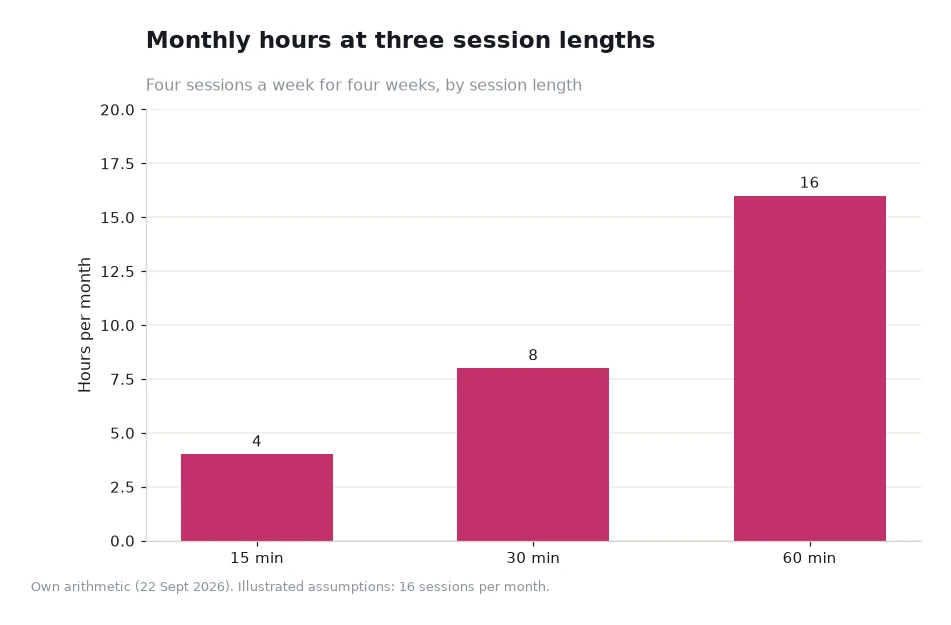
- Session length is the real audition budget — 16 visits a month is 4.0 hours at 15 minutes each and 16.0 hours at 60.
- A three-session audition at 30 minutes costs 1.5 hours, or about 19% of an eight-hour month.
- Saves, not opens, measure whether a style fits: cards that are opened and never kept are a signal about the shortlist, not the catalogue.
Why style is the part that compounds
Two cards can share a tag row and behave nothing alike. One answers in two lines and waits for you; another writes three sentences and moves the scene along itself. Neither is better, but only one of them will suit the way you actually type, and the mismatch is invisible until the conversation is under way.
The official framing of the category makes the point for you: the platform describes companions that adapt to your personality and remember your preferences, and that description only pays off over repeated sessions with the same character. A card chosen for looks alone starts from zero every time, because nothing about the choice was based on anything that accumulates.
There is a second reason to lead with style. The catalogue is wide, so the cost of a bad pick is not the pick itself — it is the fortnight spent on it before you admit the fit is wrong. Style screening moves that discovery into the first half hour.
Four axes worth scoring before you open a chat
Pace is the length and rhythm of the replies. If the card opens with a paragraph, expect to write paragraphs back; if it opens with an aside, you can steer with short turns. Initiative is who moves the scene: some cards advance it themselves, others hand every beat back to you. Register is the tone — dry, warm, playful, formal — and it usually survives the first exchange and then either settles or grates.
Scenario appetite is the fourth axis, and the official wording covers it: immersive roleplay on one side, intimate scenarios on the other. A card built for a running storyline will feel underused in a five-minute check-in, and a card built for a quick exchange will feel thin inside a long one.
The tag row gives you a rough preview rather than an answer. Tags such as Unfiltered, Submissive, Fictional, OC and Female can hint at register or at whether the character is the author's own creation, but no tag tells you how a card holds a conversation. That is what the first session is for.
| Axis | Signal before you open | What the first session reveals |
|---|---|---|
| Pace | The length of the card's opening message | Whether replies fit the length of your own turns |
| Initiative | How much of the opening scene the card sets up alone | Whether you must prompt every beat or can simply answer |
| Register | Tag row and any creator notes on the card | Whether the tone still fits after five exchanges |
| Scenario appetite | Tags such as Fictional or OC, or a stated setup | Whether the story or the exchange is the point |
| Memory | Nothing visible on the card itself | Whether a detail from earlier comes back unprompted |
Worked example: budgeting an audition
Session length is the currency you spend on judging a style, so run the arithmetic before you start. Sixteen sessions a month — four a week for four weeks — totals 4.0 hours at 15 minutes each, 8.0 hours at 30 minutes, and 16.0 hours at 60.
A fair audition is three sessions with the same character at half an hour, which is 1.5 hours. Inside an eight-hour month that is roughly 19% of your time. Two auditions run back to back take 3.0 hours, or about 38%, and still leave 5.0 hours for whichever card wins.
Compare that with the alternative: five characters opened for ten minutes each and none revisited. That is 50 minutes spent and nothing learned, because no style had long enough to show whether it holds. The audition budget exists to stop that pattern, not to add ceremony to it.
Reading the official framing without over-reading it
The page at https://crushon.ai/ai-sex-chat is the clearest statement of what the product claims to do, and three phrases in it are worth taking literally. Adapts to your personality is a claim about responsiveness. Remembers your preferences is a claim about persistence. Immersive roleplay or intimate scenarios is a claim about range.
Read together, those phrases describe a product whose value grows with repetition, which is exactly why style screening beats appearance screening. A card that fits your pace and register has something to compound; a card that does not will restart at zero every session no matter how many times you open it.
Two habits make the screening cheaper. Keep a short shortlist rather than a long one — three candidates is plenty for a month — and keep a written note of your monthly hours so the audition budget stays visible. The AI chat blog covers the mechanics of prompting and pacing, and the NSFW AI trends page is a reasonable place to find candidates worth an audition in the first place.
Where a shortlist should come from
Three candidates a month is a small number, so it helps to be deliberate about where they come from. Crushon's weekly rankings rebuild every Thursday, which means a card that holds a place for two consecutive weeks has already passed a filter you did not have to run yourself.
One further filter is worth applying before you open anything: how many sessions you are prepared to give a single card. A character that needs five sessions before its register shows is not necessarily poor, but it is expensive inside a month that only holds sixteen sessions.
The same discipline keeps the audition budget honest. Sixteen visits a month sounds generous until a failed pick is counted properly — three half-hour auditions, then a fortnight spent returning to a card that does not fit. Candidates chosen deliberately make that waste occasional rather than routine, and the notes you take while auditioning become the rule you apply next month.
Frequently asked questions
Should I choose a companion by appearance or by tags?
Neither on its own. Tags like Unfiltered or Fictional narrow the field usefully, but pace, initiative and register only show themselves once a session is running.
How long does it take to tell whether a style fits?
Three sessions of about half an hour is a fair audition — 1.5 hours, roughly a fifth of an eight-hour month at 16 visits.
What does the platform actually promise?
That companions adapt to your personality and remember your preferences. That is a claim about improvement over repeated use, which is why the same card is worth revisiting before it is replaced.
Audition three, then commit
Write down the four axes, give three cards a real audition rather than a glance, and keep the winner for a fortnight before reopening the search. The catalogue will still be there when you next look at it, and a style you have tested is worth more than a card you have only seen.
Data and sources: the product description and card tags published on CrushOn.AI[1], read 22 Sept 2026. Session-length hours and the audition budget are illustrative assumptions rather than platform data. This piece is published for adults aged 18 and above.